A legal team may call its risk-assessment process standardized and have a playbook or checklist. Yet its AI prompt may say only: “Assess the legal risks of this proposed feature.”
The assignment is present, but the method is missing. The tool does not know the required facts, risk criteria, escalation points, or finished format. It must guess.
A prompt states the current assignment. A playbook contains the professional method. A skill translates that method into a reusable procedure.
This article starts where personalization stops: the procedure for doing the work.
A prompt assigns the work. A skill carries the method.
The prompt is the assignment, not the method
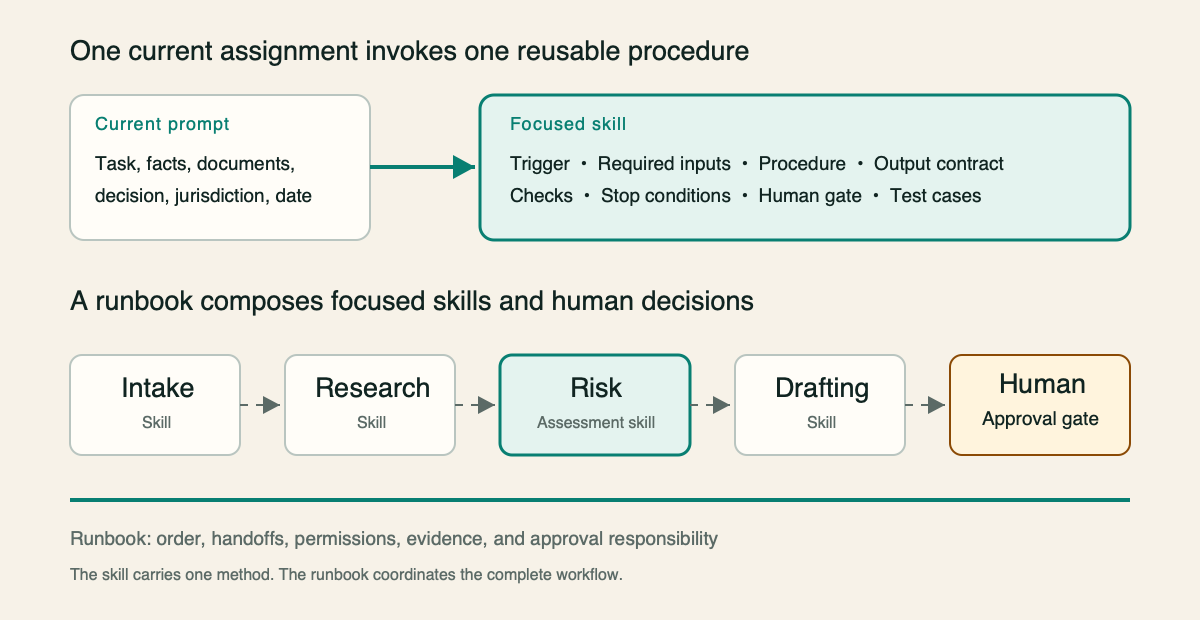
The prompt belongs in the chat box. It supplies the current task, facts, documents, decision, jurisdiction, and date. Those details change by matter.
A skill contains the repeatable method: when to use it, what information it needs, the steps to follow, what the finished work must include, checks, when to stop, and who must approve the result. It may also include templates, examples, reference materials, or scripts.
A runbook connects several skills into a larger workflow. A contract-review runbook might coordinate intake, clause extraction, risk assessment, drafting, quality review, and lawyer approval.
Prompt
Question: What do you need now?
Legal example: Assess this sanitized vendor agreement for the stated launch decision
Playbook
Question: How does the team perform this work?
Legal example: Apply the approved risk taxonomy and escalation rules
Skill
Question: How is that method made reusable by an AI system?
Legal example: Run the defined risk-assessment procedure and return the required report
Runbook
Question: How do several procedures and people work together?
Legal example: Move from intake through assessment, revision, and approval
A skill is more than a saved long prompt. Claude Skills and OpenAI agent skills package instructions and supporting resources and use progressive disclosure: the host can first consider a skill’s name and description, then load the detailed procedure when needed. Exact activation and packaging differ by product. Because a model still interprets the instructions, a skill improves consistency without guaranteeing a correct or identical result.
Start with how the professional actually works
Do not ask an AI system to invent the legal method. Capture the method that already exists.
There are three useful starting points:
An existing playbook or standard operating procedure. This provides the declared process, approved criteria, templates, and escalation rules.
A practitioner walkthrough. Ask the lawyer, paralegal, or legal-operations professional to perform the task and explain why each decision is made, including the exceptions that never made it into the written playbook.
Targeted research. Use authoritative materials and expert review when the process is incomplete, contested, or dependent on current professional standards.
The playbook is source material, not the finished skill. It may omit facts experts know to request, exceptions, or definitions of “material” and who receives an escalation.
Capture what triggers the procedure, which inputs are required, where judgment enters, which sources and tools are permitted, what failures recur, what completion means, and when the system must stop.
On Pro, Max, and Team plans in Cowork for Claude for Mac, Claude can record a demonstration and propose a Skill. The feature is not currently available in chat, on Windows, or on Free and Enterprise plans. Use a fictional demonstration in an approved workspace after closing client files, notifications, tabs, and visible metadata. A recording shows steps, not necessarily the expert’s reasoning, so the practitioner must explain the choices and review the proposal.
Encode a focused procedure
The first skill should not attempt to reproduce an entire legal department. Choose one repeated task with known inputs and a recognizable reviewed output. Write down when it should be used, the information it needs, the steps to follow, which sources and tools are allowed, what the finished work must include, the checks to run, when to stop and ask for help, who owns it, and the examples it must pass. The worksheet below makes that method easy to copy and review.
As of August 12, 2026, Nate B. Jones’s subscriber-only Open Skills page advertised 40 skills across eight categories and ten runbooks. The useful pattern is modularity: small procedures with explicit outputs, checks, and human gates that compose into larger workflows. This article draws on that architecture, not the full prompts or diagrams.
Worked example: a legal-risk-assessment skill
Assume a fictional technology company wants a preliminary risk assessment for a proposed product feature. The example uses invented, minimum-necessary facts in an approved workspace. Redaction alone does not make information permitted; a real team must also consider client restrictions and the workspace’s retention, training, logging, and connector controls.
When to use it: Use the skill when the user requests a legal-risk assessment for a defined decision.
What it needs: The decision to be made, jurisdiction and relevant date, known facts, unresolved facts, approved source set, and the organization’s approved risk criteria if available.
Steps to follow:
Require an authorized person to confirm that the information and selected workspace are approved for this use.
Separate supplied facts, unresolved facts, and assumptions.
Fix the jurisdiction and relevant date, map the issues, and verify material legal claims against current primary authority. Record source dates and citations; never invent authority, quotations, or facts.
Apply organization-defined criteria to likelihood, impact, confidence, and mitigations. Preserve “unknown” when the facts or authority do not support a rating.
Identify alternatives and escalation conditions.
Produce the required report and run the completeness checks.
What the finished work must include: A decision summary, assumptions, issue-by-issue risk table, mitigations, priority actions, unresolved questions, source status, and the required reviewer.
When to stop: Stop if the decision is unclear, a required jurisdiction is missing, the supplied facts conflict, the input is not approved for the tool, or a defined escalation condition is met.
The prompt supplies the decision, facts, jurisdiction, and date. The skill supplies the assessment method. If the method changes by jurisdiction or matter type, write that difference into the procedure or use a separate skill. Do not let the model silently improvise it or the organization’s risk appetite.
Where a legal team can use the procedure
The method can stay the same even when the product changes. What changes is how a user starts it, which approved files or tools it can reach, and which account controls apply.
Claude chat: Use a Skill with the facts and documents you provide.
Claude Cowork: Use the same Skill across approved files and tools, subject to permissions and lawyer-review steps.
ChatGPT: Use a skill in Chat or Work where your account and organization allow it.
Gemini Apps: Use a Gem for recurring instructions and approved reference files in chat.
These options are similar, not identical. Available features, permissions, and organization controls differ. Test the procedure in every product your team plans to use.
Check the work, not just how often the skill is used
A dashboard may tell you that people opened or used a skill. It cannot tell you whether the legal work was complete, well-supported, or properly escalated. Review the work itself.
For each test, ask:
Did it start at the right time? It should run for the intended requests and stay out of unrelated ones.
Did it follow every required step? It should not silently skip part of the legal team’s method.
Did it produce everything the reviewer needs? The result should contain every required section and field.
Did it identify and support the important issues? Material legal claims should be supported by valid, current authority.
Did it stop and ask for review when required? It should pause whenever a defined escalation condition appears.
How much did the lawyer have to correct? Track substantive corrections, not cosmetic edits.
Did it save review time after the work was acceptable? Time saved matters only after the work passes the quality checks.
Use realistic examples reviewed by a lawyer: a normal request, a request with missing information, a request with conflicting facts, a request that should not use the skill, and a matter that must be escalated. Re-test whenever the skill, model, tools, or source materials change.
A plain-language worksheet for your first skill
Complete this with the lawyer, paralegal, or legal-operations professional who already knows the task. It is a worksheet, not a complete skill or a matter-specific prompt. If a section is hard to complete, the playbook probably needs clarification before AI is involved.
What this skill is for
[One focused procedure and its intended result]
When to use it
[When this procedure should and should not run]
What it needs
[Facts, documents, decision, jurisdiction, date, approved criteria]
What it may use
[Permitted sources, systems, and restrictions]
Steps to follow
[First required step][Judgment or classification step][Analysis step][Output and quality check]
What the finished work must include
[Required sections, fields, and format]
When to stop and ask for help
[Missing inputs, conflicts, sensitivity, thresholds]
Who reviews and approves it
[Who must review, approve, send, file, or decide]
Examples to test
[Should run, should not run, boundary, failure, escalation]
This worksheet is a starting point, not a production-tested legal skill. Before real use, the method needs realistic tests, version history, a named owner, and approval.
Where the skill stops
A skill does not, by itself, establish current law, resolve missing facts, choose the client’s objectives, or replace professional judgment. It can require sources and checks and still misapply them.
Start with one understood playbook, test it on approved expert-adjudicated cases, measure failures, and revise. Add it to a runbook only after it meets predefined acceptance criteria for a defined, supervised use.
The goal is not to remove the lawyer. It is to move the lawyer’s effort from reconstructing the procedure to reviewing a visible method and its result.